The Remarkable History of Estwing Tools
Some tools are made to get the job done. Others become part of history. For more than 100 years, Estwing has managed to do both.
When you pick up an Estwing hammer, you’re holding more than a familiar hand tool. You’re holding a piece of American manufacturing history that stretches from a small basement workshop in Illinois to the training grounds of the Apollo space program.
The story of Estwing is filled with ingenuity, determination, unexpected opportunities, and a commitment to making tools that last.
And some of its best stories are ones that even longtime Estwing owners might not know.
It Started With One Man and an Idea
The Estwing story began in 1923 in Rockford, Illinois.
Its founder, Ernest Otto Estwing, was born in Sweden and immigrated to the United States as a teenager. He settled in Rockford, where he learned English and developed his skills as a machinist and engineer.
Ernest noticed a fundamental weakness in traditional hammers: wooden handles could loosen, split, or break under demanding use.
He believed there had to be a better way.
His solution was revolutionary for its time: a hammer with the head and handle forged from one continuous piece of solid steel.
His earliest tools were manufactured in the basement of his own home. It was a small operation, but Ernest believed strongly in his design.
In fact, the neighborhood reportedly knew when Ernest was working because the vibrations from his basement forging operation could rattle dishes in nearby homes!
A $2 Hammer That Was Twice the Price
In the early days, not everyone was convinced.
Estwing’s original hammer sold for approximately $2 in the mid-1920s. That was roughly twice the price of a conventional wooden-handled hammer.
But Ernest believed the added strength and durability justified the price.
In 1925, he placed a full-page advertisement in The Carpenter Magazine. The response was far greater than he anticipated.
Orders began coming in faster than he could manufacture the hammers in his basement.
That advertisement helped attract investors and gave Estwing the opportunity to establish its first manufacturing facility.
An idea that started in a basement was becoming a real American manufacturing business.
1934: The Rock Hammer Is Born
One of the most interesting chapters in Estwing history began with a customer request.
In 1934, a mining engineer from Arizona sent an order for carpenter hammers with a note explaining that his blacksmith had been welding pick points onto the claws of ordinary hammers.
The results weren’t good enough for breaking rocks.
He asked Ernest whether he had considered making a specialized hammer-pick for prospectors and mining professionals.
Ernest recognized an opportunity.
That year, Estwing introduced its now-famous geological pick.
The design combined a striking face, a pointed rock-breaking end, a forged steel body, and a comfortable leather grip.
It became an essential tool for geologists, prospectors, rock collectors, and eventually generations of outdoor enthusiasts.
Interestingly, Ernest himself didn’t actually get the opportunity to use one of his own geological picks in the field until 1959!
At age 74, after retiring from the company, he finally went on a rockhounding expedition in the California desert. He brought several of his own picks and spent days collecting geodes and agates.
He enjoyed the experience so much that he gave away the extra picks he had brought rather than take them home.
An Estwing Tool and the Race to the Moon
Perhaps one of the most remarkable connections in Estwing’s history involves America’s space program.
During the 1960s, NASA was preparing astronauts for one of the most ambitious missions in human history: landing on the Moon.
Astronauts needed to understand geology, recognize different rock formations, and learn how to collect samples in unfamiliar terrain.
Neil Armstrong, commander of Apollo 11, participated in geological training exercises before the historic lunar landing.
Among the tools associated with this training was an Estwing geological pick.
Think about that for a moment.
A tool developed in a small Illinois manufacturing operation, originally designed for prospectors and mining professionals, had become part of the training associated with America’s journey to the Moon.
Estwing’s own historical timeline recognizes the connection between its geological pick and Armstrong’s moon-mission training.
It is a pretty remarkable piece of history for a hand tool.
The actual lunar surface tools were specially designed for NASA, but Estwing’s place in the astronauts’ geological training is a story worth remembering.
The Leather Handle That Became an Icon
Another defining chapter in Estwing history came during the 1930s.
The company introduced its distinctive laminated leather handle.
The stacked leather construction became one of the most recognizable features of an Estwing hammer.
Beyond its appearance, the leather grip offered a comfortable and practical way to hold the solid steel tool.
It became a favorite among tradesmen, collectors, and tool enthusiasts.
Even today, vintage Estwing leather-handled hammers remain highly recognizable, and many older examples are still found in working toolboxes.
For some people, that leather grip is what makes an Estwing an Estwing.
World War II, Expansion, and the Blue Handle
Estwing continued growing through some challenging periods in American history.
During World War II, steel was rationed, and manufacturing companies faced significant restrictions.
Estwing was permitted to continue producing tools considered essential to the war effort.
After the war, the company expanded its manufacturing operations.
Then came another recognizable innovation.
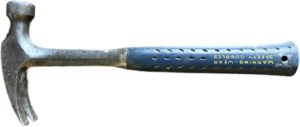
During the 1950s, Estwing began producing tools with its distinctive blue molded vinyl grips.
Unlike conventional glued-on grips, the new design was molded directly onto the steel handle.
This provided a durable alternative to the traditional leather grip while giving Estwing another signature appearance.
In the decades that followed, the company continued refining its products, eventually introducing its patented Shock Reduction Grip to improve comfort and reduce vibration.
From the Jobsite to the Smithsonian
Estwing’s history isn’t limited to construction sites, workshops, and geological expeditions.
In 2005, an Estwing hammer was added to the Smithsonian Institution’s Industry and Manufacturing collection at the National Museum of American History.
It’s a fitting recognition for a company that helped change how one of the world’s oldest hand tools was designed and manufactured.
The original concept of forging the hammer head and handle from one continuous piece of steel was a significant departure from traditional construction.
And it helped establish a design philosophy that remains central to Estwing today.
More Than 100 Years Later, Still Made in Rockford
In 2023, Estwing celebrated its 100th anniversary.
That’s a century of manufacturing, innovation, and tools used by generations of professionals and everyday users.
While manufacturing technology has changed considerably, the company’s commitment to American-made steel tools remains an important part of its identity.
Estwing continues to manufacture its all-steel hammers and axes in Rockford, Illinois, and has modernized its operations with advanced equipment and nearly 70 robots at its manufacturing facility.
From Ernest Estwing’s basement workshop to a modern manufacturing operation, the company’s history is a testament to what can happen when someone believes there is a better way to make something.
The Next Time You Pick Up an Estwing…
Think about where that tool came from.
Think about the Swedish immigrant who started a business in Rockford, the basement workshop that shook the neighborhood, the mining engineer whose request helped create a legendary geological pick, and the astronaut who used an Estwing tool while preparing for one of humanity’s greatest adventures.
A hammer might seem like a simple tool.
But after more than 100 years, Estwing has proven that even the simplest tools can have extraordinary stories.
That’s a history worth passing along.
This article is published by the Estwing Hammers & Tools Fan Club, an independent community of Estwing users, collectors, and enthusiasts. The community is not owned by or affiliated with Estwing Manufacturing Company.
Leave a Reply